
"junk removal seo" gets about 210 searches a month in the US, and "junk removal marketing" about 110. Those are DataForSEO estimates, pulled Nov 6, 2026. I'd read them as haulers, and the people who market to them, asking where to start.
What ranks today is mostly keyword lists and agency pages. This guide is the work itself, built on Google's and the EPA's own pages. I sell SEO services myself, so weigh that in.
The short version: I'd do five things, in this order.
- Give each kind of item you haul its own page, using Google's description of the trade.
- Publish a "where it goes" page: what you donate, recycle and dispose of.
- Turn jobs into before-and-after project pages.
- Publish prices from your own jobs.
- Ask every customer for a review, the same way, and check Search Console once a month.
One page per item, in Google's words
Google publishes one-line descriptions of trades for its US Local Services ads. For this trade it reads: "Junk removal professionals remove and dispose or donate appliances, waste, furniture, or other items." (Google, Local Services screening requirements)
That sentence names three kinds of item, which gives you a starting page list:
- Appliance removal
- Furniture removal
- Waste and debris removal
I'd add others only for work you actually sell, such as hot tubs, estate cleanouts or construction debris. Those are my examples, not Google's.
Each page should answer what a customer wants to know before calling:
- what you take, and what you don't
- how pricing works for that kind of item
- where it goes after it leaves (more on that below)
- the towns you cover
- a recent job of that kind, with photos
- how fast you can come, if that's true
The site layout I recommend for any trade is in contractor website structure, and the full order of work is in my contractor SEO guide.
The "where it goes" page
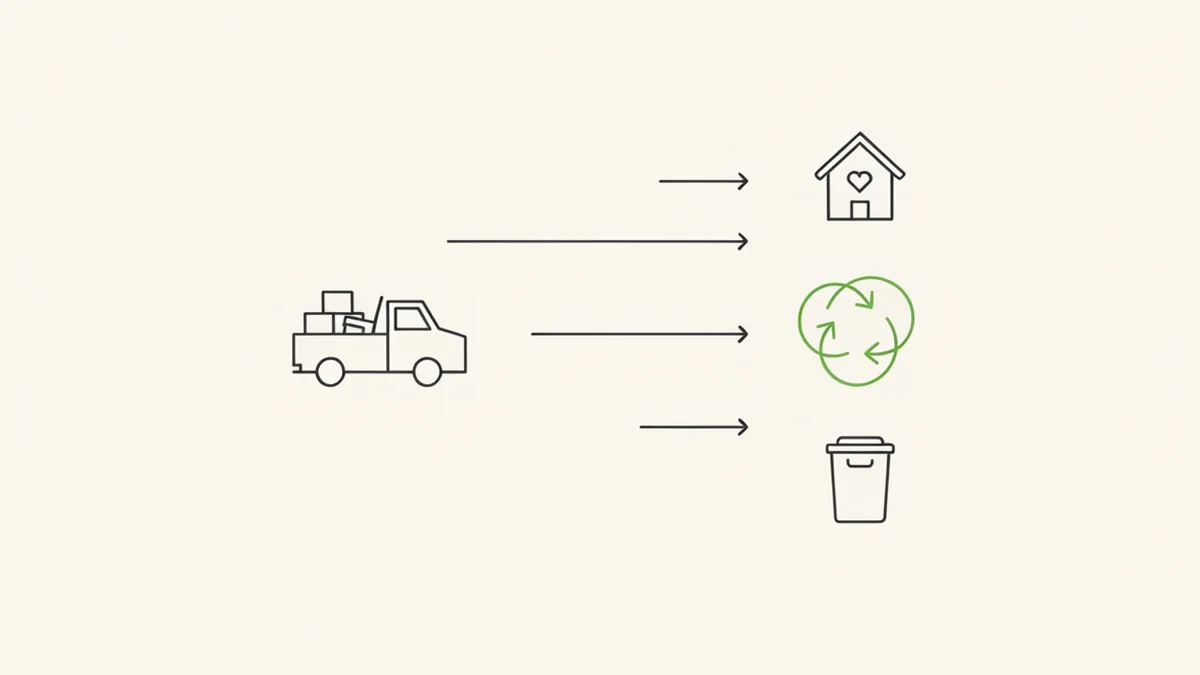
Google's description says "dispose or donate". Customers care which. A page that explains what you donate, what you recycle and what goes to the landfill answers a question many haulers' sites leave open, in my experience. It's also the kind of first-hand detail Google's helpful-content guidance asks about: "Does your content clearly demonstrate first-hand expertise and a depth of knowledge" (Google Search Central, Creating helpful, reliable, people-first content).
Two kinds of item need extra care on that page.
Old fridges, freezers and window AC units. These hold refrigerant, and the EPA has disposal rules under the Clean Air Act. Its page says: "The final person in the disposal chain (such as a scrap metal recycler or landfill owner) is responsible for ensuring that refrigerant is recovered from equipment before its final disposal." When an appliance arrives with no refrigerant left, that person keeps "a signed statement from the person who dropped off the appliance." (EPA, Safe Disposal Requirements)
So if you haul appliances, the recycler you deliver to may ask you for paperwork. I'd find out what yours needs, and then say on the page where appliances go. I'm not a lawyer, so read the EPA's page or ask your recycler which rules apply to you.
Electronics and batteries. The EPA's electronics page tells people to "Delete all personal information from your electronics." It also says: "Lithium-ion batteries and devices containing these batteries should NOT go in household garbage or recycling bins." (EPA, Electronics Donation and Recycling)
That gives you two useful lines for the page: remind customers to wipe old devices before pickup, and say how you handle batteries. Only claim what you actually do.
Before-and-after photos
A cleared garage is the clearest proof this trade has. Take the before and after from the same spot, so the change is obvious.
Each project page names five things: the job type, the town, what was there, what you hauled, and the month. Here's a hypothetical example, not a real job:
Hypothetical: Garage cleanout in Springfield, June. A two-car garage packed to the door after a move. Hauled two loads: old furniture went to donation, a dead freezer went to an appliance recycler, and the rest went to the landfill.
Ask the customer before you photograph or publish, keep house numbers, mail and family photos out of the frame, and strip the location data. File names and alt text are in my image SEO checklist for contractors, and how project pages connect to service pages is in project pages versus service pages.
Prices from your own jobs
"How much?" is usually the first thing people ask. The same Google guidance asks: "Does the content provide original information, reporting, research, or analysis?"
I'd argue a pricing page built from your own jobs answers that better than "call for a quote". Say how you price, whether by load, by item or by time, give the range your recent jobs came in at, and date it. I can't tell you what your prices should be. Only your jobs can. The same approach is in my home remodeling SEO guide.
Reviews and your service area
Google says, "More reviews and positive ratings can help your business’s local ranking." (Google, local ranking) Its Maps content policy bars businesses from offering incentives for reviews and from choosing to "selectively solicit positive reviews from customers" (Google, Maps User Generated Content Policy). I'd ask every customer when the truck pulls away, the same way every time. The longer version is in my roofing SEO guide.
You go to your customers, so on Google you're a service-area business. Google's definition is one that "visits or delivers to customers directly but doesn’t serve customers at their business address." (Google, Manage your service areas) The setup is in service area business SEO.
Where SEO fits in junk removal marketing
Two lines from Google keep SEO in proportion (Google Search Central, Do you need an SEO?):
- "If you run a small local business, you can probably do much of the work yourself."
- "Advertising with Google won't have any effect on your site's presence in our search results."
So ads and SEO are separate decisions. If you hire help for the SEO side, "No one can guarantee a #1 ranking on Google." My roofing guide walks through the rest of Google's hiring checklist.
Is it working? Check Search Console
Confirm each item page and project page is indexed first. Then a monthly look at the Performance report is enough. I'd watch for:
- Item plus town in queries. "Appliance removal" plus a town you work in, landing on the right page.
- The "where it goes" page being found for searches about donating or recycling.
- Price queries landing on your pricing page.
I won't promise rankings or calls by any date. Nobody honest can.
The next step
Give each item type its own page, say honestly where things go, publish before-and-after jobs and real prices, and ask every customer for a review the same way. If you'd rather have that done with you, see my local SEO services.
Related trade guides: Handyman marketing, Tree service SEO and Garage door SEO.
Sources
Pages fetched and checked on Oct 20, 2026, and Nov 11, 2026.
- Google Local Services Ads Help (US): Business screening and verification requirements, including the junk removal description
- EPA: Stationary Refrigeration: Safe Disposal Requirements
- EPA: Electronics Donation and Recycling
- Google Search Central: Creating helpful, reliable, people-first content
- Google Business Profile Help: Tips to improve your local ranking on Google
- Google Business Profile Help: Manage your service areas
- Google Maps Help: Maps User Generated Content Policy: Fake Engagement and Rating Manipulation
- Google Search Central: Do you need an SEO?
- Search estimates for "junk removal seo" and "junk removal marketing": DataForSEO Labs, United States, pulled Nov 6, 2026