
Carpenter is my last name, not my trade. I run a small SEO practice, and for a month Google showed my site to people searching for carpenters. Nobody clicked, and they were right not to. That accident is the clearest lesson I have about SEO for carpentry businesses.
The short version: I'd do four things, in this order.
- Set your Google Business Profile up for your trade, with the services you actually do.
- Give each kind of job you want more of its own page.
- Put real photos of finished work on every one of those pages.
- Check Search Console once a month, and expect slow.
Carpenters sell jobs, not a trade
Nobody searches for "a carpenter" the way they search for "a plumber". Carpentry is a hundred different jobs, and the buyer searches for the job.
The Bureau of Labor Statistics describes the trade in one sentence. Carpenters "construct, repair, and install building frameworks and structures made from wood and other materials" (BLS, Carpenters). A quarter of carpenters are self-employed, by the same source. That one sentence hides at least five different jobs.
| Kind of job | Who buys it | What they type |
|---|---|---|
| Built-ins and cabinets | Homeowners | "built-in bookshelves", "custom closet", the town name |
| Trim and finish work | Homeowners and remodelers | "crown molding installer", "finish carpenter near me" |
| Decks, pergolas and fences | Homeowners | "deck builder", "pergola" plus the town |
| Framing and structural work | Builders and general contractors | "framing contractor", "framing crew"; often not Google at all |
| Repairs | Homeowners | "rotted wood repair", "door frame repair" |
The BLS duty list reads like that table. Carpenters "install structures and fixtures, such as windows and molding". They "construct and install building frameworks, including walls, floors, and doorframes". They "inspect and replace damaged framework or other structures and fixtures". Each duty is a different search, from a different person, at a different moment.
Builders and remodelers are different. In my experience they find framing and finish crews through other builders, suppliers and past jobs. A website is where they check you out before calling, rarely where they found you.
So the first decision is which of these jobs you want more of. Everything below follows from that.
What my own Search Console says about carpenter searches
Here's the accident. Between October 5 and November 1, 2026, Google showed my site for ten searches that contain the word "carpenter" or "carpentry". Together they produced 232 impressions and zero clicks. The chart is drawn from my own export.
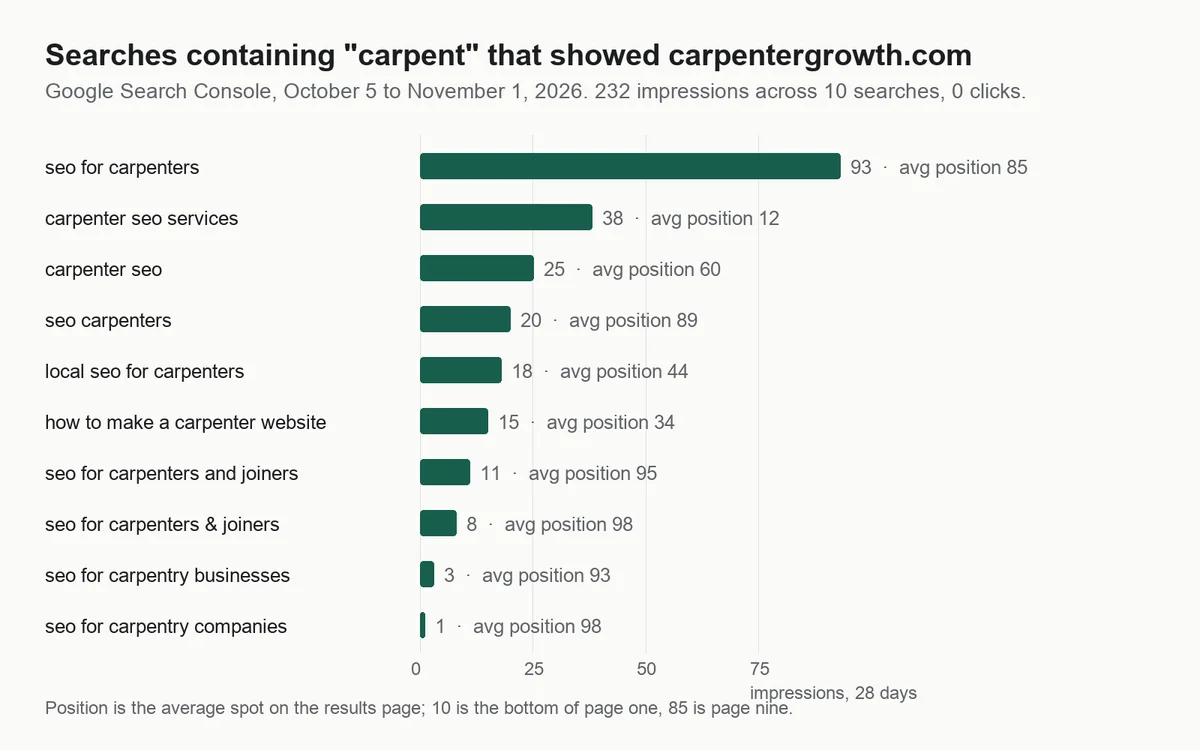
The chart averages every page the site was shown on. The positions below are for the page that took most of the impressions:
- "seo for carpenters" was shown 93 times, almost all on my contractor guide, at an average position of 85. Page nine. Nobody scrolls there.
- "carpenter seo services" was shown 38 times, 27 of them for my home page at position 7. That's the name match, not the trade.
- "local seo for carpenters" was shown 18 times, with my local SEO service page at position 19.
- "how to make a carpenter website" was shown 15 times, landing on my website-structure guide at position 34.
I don't do carpentry. Google saw the word "Carpenter" in my business name and some contractor guides, and took a guess.
That is exactly what happens to a carpentry business with no page for the job. Google matches a word somewhere on the site, places the page deep, and nobody clicks. An impression at position 85 is not visibility.
The fix is the same for me and for you. When a page exists for the thing people search for, the matching stops being a guess. This article is that page for me; your built-ins page is yours.
Start with the Google profile, set for your trade
For a carpentry business that works at the customer's home, the Google Business Profile is the first page most buyers see. Google says local results "are mainly based on relevance, distance, and popularity" (Google, Tips to improve your local ranking). It defines relevance as "how well a Business Profile matches what someone is searching for".
That sentence tells you what to fix. Four things, in order:
- Pick the category Google offers for your trade. Look in its picker for carpentry, cabinetry and decks. Choose the one that matches most of your work, and add the others as secondary categories.
- List the services you actually do. Built-ins, trim, decks, framing, repairs. Google reads that list when it decides whether you match a search. Skip the services you don't want.
- Set it up as a service-area business if you work at the customer's site and have no showroom. Google's own advice: make sure your "business info is as complete as possible".
- Add photos of finished work, and ask every customer for a review. Google says "more reviews and positive ratings can help your business's local ranking".
The full profile method, step by step, is in Part 1 of my contractor SEO guide. I won't repeat it. The carpentry-specific part is the category and the services list, so do those two with care.
If you'd rather watch the setup, this six-minute walkthrough covers the category and service-area steps.
One page per kind of job you want more of
This is the core of the work, and the part most carpentry sites skip. A site with a home page, a gallery and a contact page has no page for "deck builder". So Google guesses, as it did with mine.
Pick the jobs from the first table that you want more of. Give each one its own page. Not a "Services" page with a list, because that's one page about nothing in particular.
Each job page needs five things:
- What the job involves, in plain words. For framing, the BLS wording is close to right: walls, floors and doorframes. For built-ins, say what you build and from what.
- Three real projects, each with photos and a sentence about the problem and the result.
- The towns you serve for that job. Framing crews travel further than trim carpenters; say so.
- What you don't do. If you don't build decks, say it. It saves both sides a call.
- One way to reach you. A phone number and a short form, not a wall of buttons.
If you're a one-person shop, start with two pages, not five. Pick the job that pays best and the one you get asked for most. Add the rest as the photos come in.
The layout I recommend for any trade is in contractor website structure. It also answers the question I keep seeing in Search Console, how to make a carpenter website at all. The site shape behind it is in Part 2 of the contractor guide. Plumbers and home builders get the same advice in SEO for plumbing businesses and SEO for home builders.
Photos are the proof in this trade
A plumber can describe a repair. A carpenter has to show it. The joint, the reveal, the grain matched across three cabinet doors: that's the pitch.
So the photos are not decoration on a job page. They are the page. Three rules:
- Shoot every job before the furniture goes back in. An empty room with new built-ins reads as your work. A full room reads as someone's living room.
- One set per job type. Deck photos on the deck page, trim photos on the trim page. Don't pool them in a gallery nobody can search.
- Ask the homeowner before you publish, and never show a street address. The town is enough.
Name the files for what they show, write alt text that describes the photo, and keep them small. My image SEO checklist for contractors covers that in full. The argument for photography as proof is in Part 3 of the contractor guide.
What to check in Search Console, and when
Search Console is free, and it answers two questions. Can Google see my pages? And what is it showing them for?
Check the Pages report first. Each job page should be listed as indexed. If one isn't, nothing else about it matters yet.
Then, once a month, the Performance report, filtered to each job page. Three things, in order:
- Impressions. Is the deck page being shown for deck searches at all?
- Position. A new job page usually starts deep; my contractor guide sits at 85 for a query it was never written for. Movement toward page one or two is the signal, not the starting point.
- Clicks. These arrive last. A page at position 30 gets impressions and no clicks, which is normal for a new page.
Expect slow. A page built for the job starts further ahead than mine did, but it still needs months, not weeks. I explain the method, and the patience, in the measuring section of the contractor guide.
I won't promise a position or a date. Nobody honest can.
Can you do this yourself?
Yes, most of it. In this order:
- Fix the profile category and services list. One evening.
- Pick two job types and write one page each. A weekend, if the photos exist.
- Shoot the next three jobs properly. Ongoing.
- Open Search Console and check the Pages report. Half an hour.
Where owners get stuck is the site itself: a template that can't take a new page cleanly, or a job page that isn't indexed. That's the work I do with contractors, described on my local SEO services page.
Three questions carpenters ask
How do I advertise as a carpenter?
Start with the free channels that match how people buy. A complete Google Business Profile, job pages with real photos, and reviews from every finished job. Paid ads can come later; they send people to the same pages.
Can I do SEO myself?
For a small carpentry business, yes. The list in the previous section is the whole of it. Hand off the technical parts: an unindexed page, a broken site structure, or a redesign.
Does a carpenter need a website at all?
If every job comes from builders you already know, a one-page site with photos and a phone number is enough. If you want homeowners to find you for built-ins, decks or trim, you need a page for each of those jobs. That's the website.
Related trade guides: Handyman marketing, Home remodeling SEO and Flooring company SEO.
Sources
- Bureau of Labor Statistics, Occupational Outlook Handbook: Carpenters, last modified August 27, 2026; read November 4, 2026
- Google Business Profile Help: Tips to improve your local ranking on Google, read November 4, 2026
- Google Search Console for carpentergrowth.com, Performance report, October 5 to November 1, 2026, queries containing "carpent"