You asked three companies what a video would cost and got three numbers that aren't close. That's not one of them ripping you off. It's what this market looks like from the outside, and this article is about what you'll pay, not what a videographer should charge.
Published price guides don't help much either. They give ranges so wide you can't budget from them. So here are the real 2026 ranges, why they're wide, and the three decisions that move your number more than anything else.
The short version: Most small business video lands between $1,000 and $10,000 per finished minute, and the spread is real. It tracks crew size, shoot days and revision rounds, not padding. A single-camera testimonial sits near the floor. An animated explainer sits near the ceiling. Before you ask for a quote, decide the finished length, how many setups you need, and how many revision rounds you want included. Those three answers move the price more than anything else.
What does a small business video cost?
A finished business video costs roughly $1,000 to $10,000 per finished minute in 2026. Two published 2026 pricing guides agree on that range: Colossyan (updated March 2026) and Create & Elate (July 2026). That's the honest answer, and it's useless on its own.
The range is wide because "a video" isn't one product. A two-minute testimonial shot by one person with one camera and a three-minute animated explainer with custom illustration are different jobs. They just share a word.
Two ways to price exist. Per finished minute is common for explainers and corporate pieces. Whole-project pricing is common for events, brand films and testimonials. Ask which one a quote uses, or you'll compare a per-minute rate against a flat fee and learn nothing.
| Video type | Per finished minute (2026) |
|---|---|
| Social media short-form | $500 – $3,000 |
| Testimonial or interview | $1,000 – $4,000 |
| Corporate or training video | $1,000 – $10,000 |
| Product demo | $1,500 – $5,000 |
| Animated explainer | $3,000 – $15,000 |
| Commercial or brand film | $5,000 – $20,000+ |
Sources: Colossyan (2026); Create & Elate citing Vidico's 2026 pricing guide. The first five rows appear in both guides; the brand-film row is from Create & Elate only.
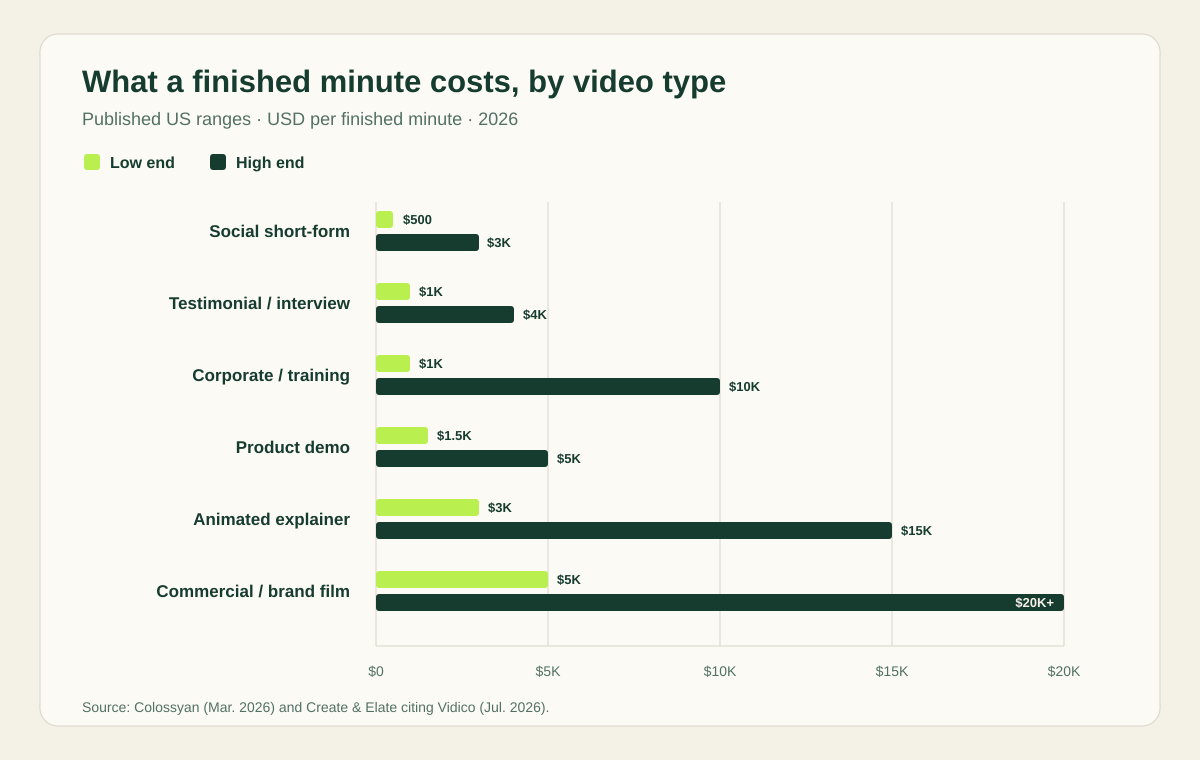
What you'll pay by video type
The cheapest format is short social content. The most expensive is a cinematic brand film. Everything else sits between, and the whole-project totals matter more than per-minute rates once a video runs past two minutes.
Whole-project ranges from Create & Elate's 2026 guide, citing Vidico:
- Corporate video: $4,500 – $20,000
- Brand film: $5,000 – $60,000+
- Full-day event coverage: $3,000 – $7,000
- Testimonial shoot: $3,500 – $20,000+
Colossyan puts a two-to-three-minute corporate video at $2,000 – $30,000 total. Notice that its floor is lower and its ceiling is higher than the corporate range above. Two guides, same product, different spans. That's your first clue that the number isn't about the video. It's about who shows up to make it.
Why two quotes for the same video differ by four times
Here's the part no pricing guide explains. The two 2026 guides I've cited disagree, sharply, on what one videographer costs for a day.
Colossyan lists a freelance videographer at $1,000 – $4,800 per day. Create & Elate, citing a 2026 crew rate guide, lists a solo videographer at $600 – $1,200 per day. Same job title. The top of one range is four times the top of the other.
Neither is wrong. They're describing two different people.
The $600-a-day person shows up with a camera. You direct, you plan, you decide what "done" looks like. The $4,800-a-day person shows up with a plan, a shot list and insurance. They also bring the judgment to know when the interview is good enough to stop. One is labour. The other is a producer.
The full-crew number makes the same point. Colossyan puts a crew — director, cinematographer, gaffer, sound, production assistant — at $3,000 – $8,000 per day. Create & Elate's individual rates add up the same way. A director of photography runs $800 – $3,000, a sound mixer $600 – $1,200, an editor $500 – $1,500.
So when three quotes come back miles apart, the first question isn't "who's overcharging." It's "who's bringing what." A quote that doesn't say is a quote you can't compare.
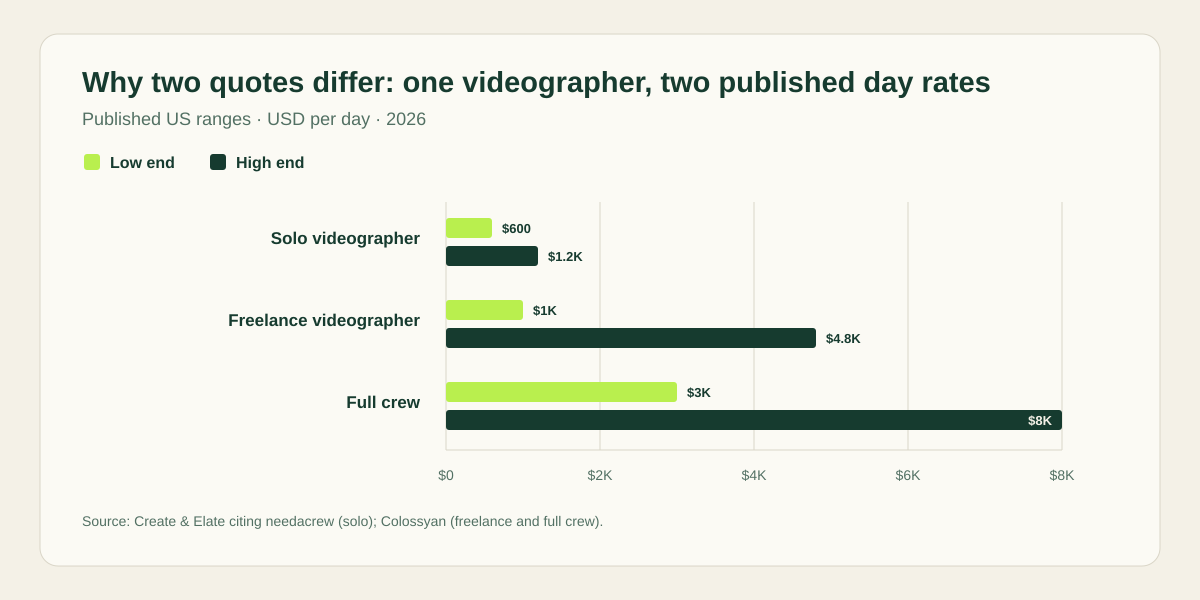
Where the money actually goes
Roughly half of a video budget is the shoot itself. The rest splits between planning and the edit.
Create & Elate's guide, citing Vidico, breaks a typical budget into pre-production at 15–25%, production at 40–55%, and post-production at 25–35%. Treat those as proportions, not rules. But notice where the small numbers sit.
Pre-production is the part businesses try to skip. It's also the cheapest place to fix a problem. A shot list that catches a missing interview costs an hour. Discovering it in the edit costs a second shoot day.
Post-production is where scope creeps. Colossyan lists basic editing at $75 – $150 per hour and motion graphics at $150 – $300 per hour. A "small change" to an animated sequence is not small.
What drives your price up
Four things move a quote more than anything else, and none of them is the camera.
Extra shoot days. Every day adds crew, equipment and location again. Two locations on one day is cheaper than one location on two days.
Revision rounds. Both guides agree: rounds beyond the one or two included cost $500 – $2,000 each. Decide who approves the video before the shoot, and how many rounds you'll fund.
Rush timelines. Create & Elate cites a 25–50% premium for rush delivery. If the video is for an event, book the shoot when you book the venue.
People and rights. On-screen talent runs $500 – $1,500 per day in both guides. Licensed music, usage rights and voiceover are separate lines. Ask whether the quote includes rights to use the video everywhere, forever, or only on one platform for a year.
A quiet fifth driver is finished length. Per-minute pricing punishes long videos, but a 90-second cut and a four-minute cut from the same shoot cost nearly the same to produce. The difference is edit time. Budget by shoot days and setups, not by runtime.
How to budget before you call anyone
Decide three things first: the finished length, the number of setups, and how many revision rounds you want included. With those, any producer can quote you accurately. Without them, you'll get a guess.
Then send the same brief to two or three companies and ask each to itemise against this list:
- Number of shoot days and locations
- Setups per day (each interview, each scene)
- Crew roles on set, by name of role
- Revision rounds included, and the cost of extras
- Licensed music, and whether the licence covers paid ads
- Captions and aspect-ratio versions (16:9, 9:16, 1:1)
- Usage rights: where, and for how long
- Delivery date, and what "rush" would cost
Two itemised quotes are comparable. Two lump sums are not. This checklist is the single most useful thing on this page, and it's free.
When a retainer beats per-project pricing
If you'll make roughly four or more videos a month, a retainer usually costs less per video. If you'll make two a year, it won't.
Create & Elate's guide lists 2026 retainer tiers from $750 – $2,000 a month at the low end to $10,000 – $20,000+ at the enterprise end. It also cites Vidico's claim that businesses producing four or more videos a month save 15 to 25% per video against project pricing. That saving figure comes from one vendor's guide, so treat it as a claim, not a law. The logic holds, though: crews that know your brand plan faster and shoot faster.
Most small businesses aren't there yet. Start per-project, keep the footage, and revisit a retainer once video is a habit rather than an event.
Frequently asked questions
How much does a four-minute video cost?
About the same as a two-minute video from the same shoot, plus edit time. Length matters less than shoot days and setups. Ask what the extra minutes add in the edit, not what they add per minute.
Is it cheaper to shoot it myself?
Cheaper in cash, yes. Whether it's cheaper overall depends on what the video has to do. A phone video that proves you're a real person is fine. A phone video that has to justify a premium price usually isn't. My honest rule is in the video marketing guide.
What should be included in a video quote?
Shoot days, setups, crew roles, revision rounds, music licensing, captions and aspect-ratio versions, usage rights, and delivery date. If a quote lists fewer than six of those, ask for the rest before you compare it to anything.
Do prices differ by city?
no data — the guides cited here publish national US ranges. Local rates vary; treat the ranges as a starting point and itemise the quote.
The next step
- Decide length, setups and revision rounds before you ask anyone for a number.
- Compare itemised quotes only. Lump sums hide the differences that matter.
- The producer is the price. Know whether you're hiring labour or judgment.
If you're in Dallas–Fort Worth and want the production handled by someone who's done this for twenty years, see my video production work. It's local only; I don't travel for shoots. Everywhere else, start with the video marketing guide linked above, and see the Dark Rainbow case study for what a real production project looks like. If original visuals are part of a bigger search problem, photography for high-ticket businesses is the companion read.
Sources
- Colossyan, "Video Production Costs: 2026 Pricing Guide" — https://www.colossyan.com/posts/video-production-costs/ (updated 2026-03-28)
- Create & Elate, "How Much Does Video Production Cost? Real 2026 Rates" — https://www.createandelate.com/blog/how-much-does-video-production-cost/ (2026-07-17), citing Vidico's 2026 pricing guide and needacrew's 2026 crew rate guide
- Not used: a "$42,281 average project" figure attributed to a Clutch survey (no sample size or date published; source page unreachable 2026-09-07) and an AI-cost-reduction claim with no primary source.