
A pest control company sells two different things. One is a treatment for a pest someone has right now. The other is a plan that brings a technician back on a schedule. Your website needs to sell both, and Google needs to tell them apart.
In Texas, the state license already splits pest work into categories. Those categories make a good first page list. So this guide to SEO for pest control companies starts with the license, then the pests, then the plans.
"seo for pest control" gets about 880 estimated US searches per month (DataForSEO, pulled September 2026). Those read as owners looking for help, like you. This guide doesn't pitch until the last line.
The short version: I'd do five things, in this order.
- Read your license before you write a page.
- Set up the Google Business Profile for a company that travels to customers.
- Give each pest group you treat its own page.
- Keep one-time treatments and recurring plans on separate pages.
- Show your license, and document real jobs with the evidence pest work leaves.
The Texas license is your first page list
The Texas Department of Agriculture licenses this trade through its Structural Pest Control Service. Its licensing page sets out the categories a license can cover (TDA, Structural Pest Control Licensing). The ones most home-service companies deal with are:
- Pest control. Pests that invade buildings "but do not normally attack the building itself, as for example, roaches, silverfish, ants, flies, mosquitoes, rats, mice, etc."
- Termite control. "Inspection and/or control of termites, beetles or other wood destroying organisms by means other than fumigation in buildings."
- Lawn and ornamental, for pests of plants, trees and lawns.
- Weed control, around homes, buildings and other sites.
There are three more: structural fumigation, commodity fumigation and wood preservation.
Here's why this matters for a website. The same page lists "advertising such services" as part of structural pest control. And TDA's business license page is blunt: "A business or person cannot advertise to provide pest control services or solicit business without first obtaining a business license and having an applicator certified in each license category in which business is to be conducted" (TDA, Structural Pest Control Business).
So I'd start every pest control site with one question. Which categories is your company licensed in? Build pages for those. Leave the rest off until you have a certified applicator for them. A termite page on a site with no termite license is a page I wouldn't publish.
I'm not a lawyer, and this is Texas only. If a service sits near a category line, ask TDA before you put it online. Other states have their own rules.
What Google calls pest control
Google publishes its own one-line definition of the trade, on the screening page for its US Local Services ads. "Pest control professionals inspect and remove various types of pests, including bugs and rodents" (Google, Local Services screening requirements).
That's two verbs, inspect and remove. A site that only talks about spraying misses half of it. Give inspections their own place, especially for termites.
The same page lists a state-level business license and owner license under pest control. The asterisk on those lines reads "* = Where applicable by local law." It also says advertisers "must have a public and verified Google Business profile to advertise with Local Service Ads."
All of this is about the paid ads only. Nothing on the page ties it to your free map or search rankings.
Set up the profile for a company that travels
Most pest control companies go to the customer. That makes you a service-area business, or a hybrid one if customers also come to your office. Most local SEO for pest control starts here.
Google sets the limits on its service-area help page. "You can have up to 20 service areas," and "If you don't serve customers at your business address, remove your address from your Business Profile." The full setup, step by step, is in my home-service Google profile guide.
One page per pest group you treat
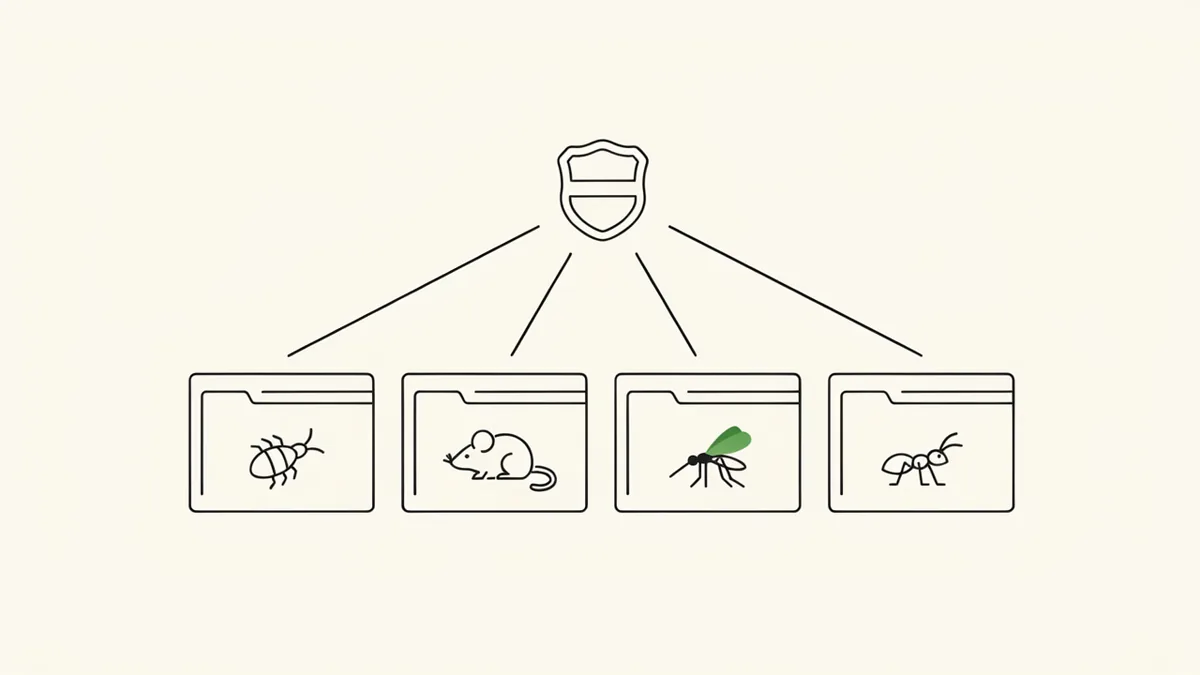
Someone with a rat in the attic is thinking about the rat. Pages built around the pest match that. Using the license categories as the frame, a typical list looks like this:
- Termites. Inspection, treatment and what happens after. This is the page with the most to explain, so it gets its own sections below.
- Rodents. Rats and mice: inspection, exclusion and removal.
- Mosquitoes. Yard treatments, if your license covers that work.
- Ants, roaches and other indoor pests. One page each where you get regular calls, or a single page for the rest.
Write one page per pest you actually treat. A list of twenty pests on one page says little about any of them.
A useful pest page answers what a homeowner checks before calling:
- what the pest looks like and the signs it leaves
- how you inspect for it, and how you treat it
- the cities you work in
- recent jobs, with photos
- your license number and how to reach you
The layout that ties pages like these together is in contractor website structure.
One-time treatments and plans need separate pages
A one-time treatment and a quarterly plan are different purchases. The first buyer has a problem now. The second is deciding whether to sign up for a year. Give each its own page.
- One-time pages answer: what you do on the visit, how soon you can come, and what happens if the pest comes back.
- Plan pages answer: how often you visit, what's covered, what isn't, and how to cancel.
Termite plans need extra care in Texas. TDA's termite FAQ says "Annual retreatment of the structure is prohibited unless there is clear evidence that re-infestation or barrier disruption has occurred" (TDA, Termite FAQs). That line is about subterranean termite retreatments. So a termite plan page shouldn't read like a yearly treatment. Describe what the plan actually includes, such as inspections and the warranty terms.
The warranty is worth explaining on the page, too. TDA requires termite disclosure documents "at the time a bid is submitted and prior to treating." They include "the complete details of the warranty provided," among other items. If the homeowner will see those terms at the bid anyway, a plain summary on your site helps them understand what they're signing.
Termite swarms are the season to plan for
I don't have search-trend data for pest control, so I won't tell you which months each pest peaks in. There's one seasonal pattern I can source, and it comes from the regulator.
TDA's termite FAQ says "Subterranean termites are often detected during swarming, usually in the spring, when some fly from their nests to start new colonies." It also says "Termites generally swarm once a year for a period of about twenty-four (24) hours."
That's a short window, and homeowners notice it. So I'd have the termite page in good shape before spring:
- Say what swarmers are, and that seeing them is a reason to book an inspection.
- Tell people what to keep. TDA says "It is helpful to save several of the swarmers in a plastic bag for the inspection by your local pest control operator before a termite treatment is performed."
- Get the type right for your area. TDA says subterranean termites "are found throughout Texas," while drywood termites are "found more commonly in coastal areas such as Houston and Corpus Christi." A company in Dallas–Fort Worth would lead with subterranean termites.
A page that's ready doesn't mean it ranks by spring. The point is to be ready when people start looking.
Put the license where homeowners look
TDA tells homeowners to check. In its termite FAQ: "Ask the company to provide verification of licensure." And: "You may also call SPCS to confirm that the company has a license."
So I'd make that check easy. Put your TDA business license number in the site footer and on every service page. Name your licensed categories on your about page.
This is my recommendation, not a TDA rule for websites. TDA's own required statement, "Licensed and Regulated by: Texas Department of Agriculture," is for your printed contracts, warranties and similar paperwork. Its business page lists exactly which documents.
The proof a pest job leaves
Pest jobs leave evidence that's easy to photograph. TDA lists some of the signs of subterranean termites, including "shelter tubes primarily composed of mud on the surface of walls, joists, piers, chimneys, plumbing and other fixtures." It also describes bait stations, which some companies install and monitor.
So a technician's phone can record:
- mud tubes on a slab edge or a pier, before treatment
- a sealed entry point after rodent exclusion
- a bait station installed at the side of a house
- a crawl space before and after cleanup
Every write-up names four things: the pest, the city, what you found and what you did. That's enough for a short job page or a profile post. Here's a hypothetical example, not a real job:
Hypothetical: Termite inspection in Grapevine. The homeowner saw swarmers near a back window in spring and kept a few in a bag. The inspection found mud tubes along the slab edge. Treated for subterranean termites and set a follow-up inspection.
Four rules keep this honest and safe:
- City only. Never a street address or a house number in the frame.
- Ask the homeowner first. No photo or page without their consent.
- Strip the location data. Phone photos can record exactly where they were taken. Remove that data before any photo goes online.
- Nothing personal in the frame. No faces, family photos or mail. Crop when in doubt.
For file names and alt text, use my image SEO checklist for contractors. Each job write-up should link to the pest page it proves. The method is in project pages versus service pages.
Reading Search Console month to month
Once a month, open the Performance report in Google Search Console and look page by page. For each pest page, ask two questions. Is it showing up at all? And are the searches it shows for about that pest, in your towns?
If your termite page is showing for rodent searches, the pages are blurred together. Tighten each one to its own pest.
Once you have a year of data, compare each month with the same month last year. A spring jump on the termite page fits the swarm season. Check it against last spring before you change anything.
I won't promise rankings or calls by any date. Nobody honest can. The wider method, for every trade, is in contractor SEO: the complete guide.
What to do yourself, and what to hand off
Most of this is owner work.
Do yourself:
- Check which license categories you hold, and match your pages to them.
- Write one page per pest you treat, and separate pages for plans.
- Get the termite page ready before spring.
- Photograph jobs, strip the location data and ask homeowners for consent.
Get help with:
- Pages that Search Console says aren't indexed, when you can't tell why.
- Merging or splitting pages on an existing site without losing what already ranks.
- Telling a seasonal change from a real problem in your Search Console data.
Those are the parts where a wrong move is hardest to undo.
The next step
Match your pages to your license, give each pest its own page, separate one-time treatments from plans, and show your license. If you'd rather have that done with you, see my local SEO services.
Related trade guides: Landscaping SEO, Tree service SEO and HVAC SEO.
Sources
Pages fetched and checked on Oct 20, 2026.
- Texas Department of Agriculture: Structural Pest Control Licensing
- Texas Department of Agriculture: Structural Pest Control Business
- Texas Department of Agriculture: Termite FAQs
- Google Local Services Ads Help (US): business screening and verification requirements
- Google Business Profile Help: Manage your service areas
- Search estimate for "seo for pest control": DataForSEO, US, pulled Sept 8, 2026